


As dental hygienists, magnification is one of the most important tools we use every day. I didn’t get loupes until I was two years out of school and immediately noticed a difference when practicing with magnification. What I didn’t know then was that while my new loupes provided magnification that helped with visibility and precision, not all loupes are truly ergonomic. For a loupe to be ergonomic, it must support us in a neutral position, and I learned too late that not all loupes are created equal in this regard. While they provided the magnification I needed, they still forced me into a forward head posture, my ear positioned in front of my shoulder, which added significant strain to my neck and back (Figure 1).
Research shows the human head weighs about 10–13 pounds, roughly the weight of a bowling ball. When the head moves forward, the load on the cervical spine increases dramatically as the muscles of the neck and upper back work harder to support it.1 Over time, this contributes to the high rates of musculoskeletal disorders seen in dentistry.
Unfortunately, I experienced this firsthand. I developed bulging discs and severe low back pain that made me question whether I could stay in clinical dentistry long term.

Everything changed when I got certified in ergonomics, learned what a neutral posture is, and started to understand what makes a loupe truly ergonomic. I invested in ergonomic loupes, and the difference in decreased pain, increased chairside comfort, and increased energy was too significant to ignore. I maintained an upright, neutral head position while still clearly visualizing the oral cavity and my patient (Figure 2).
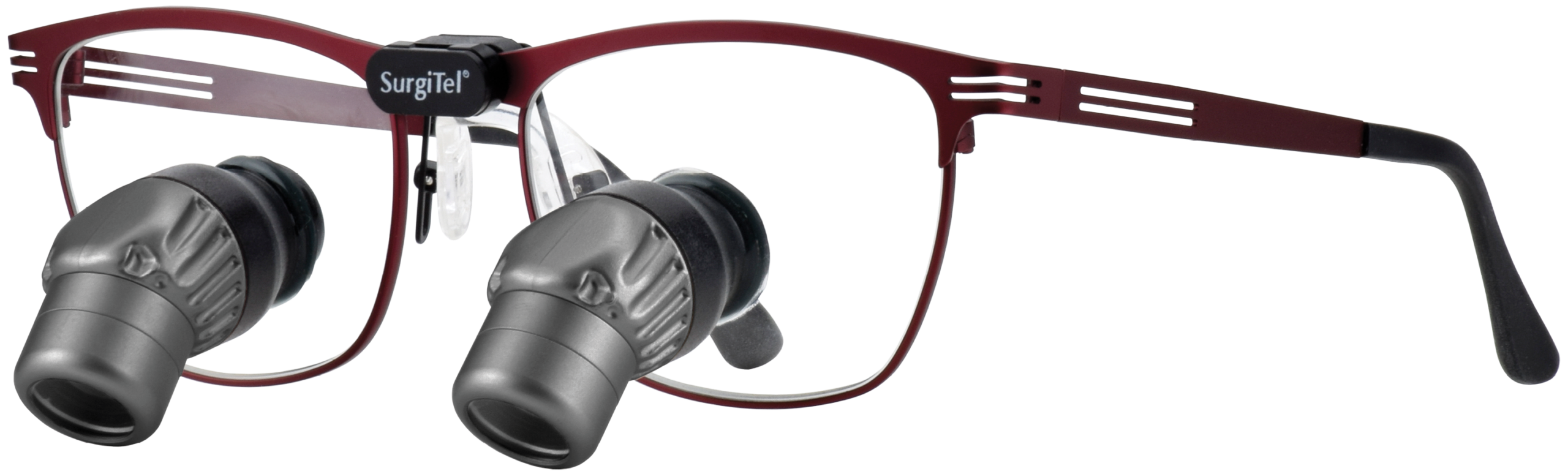
Purchasing loupes is a large investment, and many aren’t sure what loupes are right for them. I will share my experience with two types of loupes from SurgiTel: the Ergo IQ™ and Hybrid Ergo™.
No matter what style of loupe you choose, keep in mind that the closer we can keep our hands to our body’s core, the more stability, leverage, and fine motor control we gain. A well-designed loupe system with the right declination angle and working distance allows clinicians to maintain a compact, balanced posture with relaxed shoulders and elbows close to their body. This improves precision while reducing fatigue during long clinical days.
The Advantage of SurgiTel Ergo IQ Loupes™
SurgiTel’s Ergo IQ™ loupes, built with a deflection prism, allow clinicians to maintain an optimal head and neck position while still clearly seeing and working on their patient without sacrificing posture. Using these loupes is one of the main reasons I can have such good posture in the operatory. These were not available early in my career, but after 13 years of practicing with traditional, non-ergonomic loupes, I was able to make the switch to these and haven’t looked back. I have had the opportunity to try several brands of ergonomic loupes, and have learned some key differences that clinicians should consider.
Many ergonomic deflection loupes position the oculars higher on the frame, which can partially obstruct your natural line of sight. This can make it harder to quickly glance at a monitor or maintain eye contact with a patient without adopting awkward head positions or taking the loupes off entirely.
One feature I immediately noticed with the Ergo IQ™ design is the extra visual space around the oculars (Figure 3), making it easier to check the patient, view the computer, or review radiographs without removing the loupes or forcing your neck into awkward positions. I also noticed how lightweight they felt the first time I put them on—something that matters when you’re wearing magnification for hours every day.
One key aspect to consider with deflection-style loupes is how you practice. Ergonomic deflection loupes can be less forgiving when patient positioning, the distance between the clinician and the patient, or working distance changes frequently. Clinicians with long-standing habits, skeletal adaptations, or different practice styles may find them harder to adjust to.
When Hybrid Ergo™ Loupes May Be a Better Fit

As an ergonomics specialist, I recognize that no single loupe design works for everyone.
Hybrid designs combine the postural benefits of ergonomic loupes with the flexibility of traditional direct-vision loupes. When I tried them, I was pleasantly surprised by how minimal the forward head tilt was, especially compared to the traditional loupes I used earlier in my career (Figure 4).
SurgiTel’s Hybrid Ergo™ loupe allows for a steep viewing angle (crucial for maintaining a minimal forward head tilt) due to a steep declination angle combined with a low position of the oculars within the frame (Figure 5).
Many clinicians also prefer direct visualization because it feels more intuitive. It supports natural hand-eye coordination and allows better peripheral awareness of the patient’s facial expressions and body language, which can improve both precision and communication.
Why Head Position Matters
Ideally, the ear should remain vertically stacked over the shoulder, preserving the natural cervical curve and allowing the spine to support the weight of the head efficiently.
A slight head tilt is acceptable—if it stays under about 20 degrees.2 The real problem occurs when the head both tilts forward and moves in front of the shoulders, dramatically increasing strain on the neck and upper back.
Choosing the right loupes can feel overwhelming, which is why working with a knowledgeable loupe representative is so valuable.
We only have one neck and one back, and they need to last throughout our entire career. Investing in ergonomic magnification now is one of the best ways to protect your long-term health and career longevity.
References
- Lee KJ, Han HY, Cheon SH, Park SH, Yong MS. The effect of forward head posture on muscle activity during neck protraction and retraction. J Phys Ther Sci. 2015 Mar;27(3):977-9. doi: 10.1589/jpts.27.977. Epub 2015 Mar 31. PMID: 25931773; PMCID: PMC4395757.
- Valachi B. Practice Dentistry Pain-Free. Posturedontics Press; 2008.

Ms. Stephanie Botts has been a clinical dental hygienist for over 18 years. She is a Certified Ergonomics Assessment Specialist providing both in-office and virtual ergonomics consulting and coaching to dental professionals. She also provides CE to dental and dental hygiene associations on the topic of ergonomics. She has become a trusted source of ergonomics and health content, with her social media pages, which have over 100,000 combined followers, her Straight Up With Steph podcast, and her Polished Posture membership and courses. Her experience as a clinical dental hygienist and ergonomics expert has allowed her to recognize the unique challenges of practicing pain-free in the dental setting. Stephanie believes that by learning effective strategies to optimize proper ergonomics both inside and outside the operatory, dental professionals can practice pain-free and ensure career longevity. She can be reached through her website at www.polishedposture.net.