

The Hidden Cost of Cheap Optics: Why Quality Matters in Magnification Loupes

ErgoPractice News – Nov/Dec 2025
By Paul Wisniewski, CSSGB
paulw@surgitel.com
Introduction
In recent years, the optical market has seen a surge of low-cost, mass-produced loupes offered by new or lesser-known brands. Many of these products are manufactured by third-party suppliers with little or no control over optical standards, ergonomic design, or long-term reliability. While these lower-cost options may appear attractive, especially to students or early-career professionals, the reality is that poor-quality optics can lead to compromised performance, increased eye strain, and even long-term health consequences.
At the same time, established companies such as SurgiTel continue to focus on precision-engineered, high-performance optical systems that are designed to protect vision, improve posture, and provide superior long-term value. Understanding the true cost of quality is essential to making an informed decision.
The Growing Challenge: Market Saturation and Misleading Value
The loupe market has become increasingly crowded, particularly in the low-magnification segment (2.5x–3.0x), where new “pop-up” companies promise affordability but fail to deliver true optical performance. These companies typically outsource production to third-party factories that use generic lens assemblies and mass-manufactured housings.
This approach creates products that may look similar on the surface, but lack the precision alignment, optical coating, and ergonomic calibration necessary for consistent performance.
Younger professionals, especially dental and hygiene students, are often drawn to these inexpensive options because their stronger ciliary muscles allow them to compensate for poor optics by adjusting focus naturally. While this may seem fine at first, the effects accumulate over time. Constant visual strain, subtle misalignment, and inferior optical clarity can contribute to eye fatigue, neck strain, and musculoskeletal discomfort, issues that only become more pronounced with age and clinical experience.
Optical Quality and Visual Ergonomics
The defining difference between high-end and low-cost loupes lies in optical precision and visual ergonomics:
| Feature | Low-Cost, Generic Loupes | High-Quality Optics (e.g., SurgiTel) |
| Lens Material & Coating | Basic glass or acrylic, minimal coatings | Precision-ground, multi-coated optics with anti-reflective and scratch-resistant finishes |
| Optical Alignment | Hand-assembled or machine-aligned with high tolerance variation | Laser-aligned optics ensuring perfect convergence and depth accuracy |
| Field of View & Depth of Focus | Narrow and inconsistent | Wide, distortion-free field with deep focus zone |
| Customization | Limited or non-existent | Custom-built to each user’s facial geometry and working distance |
| Weight Distribution | Poor balance, leading to posture strain | Engineered for neutral head posture and all-day comfort |
| Long-Term Vision Safety | Can induce eye strain and fatigue | Designed to minimize ocular effort and promote ergonomic posture |
While low-cost loupes may provide initial magnification, they often sacrifice clarity, depth, and true stereoscopic accuracy, which are critical for procedures that demand precision and sustained visual focus.
The Real Cost of Cheap Loupes: What “Saving Money” Really Costs You
At first glance, a pair of $400–$600 loupes might seem like a smart, affordable choice, especially for students or early-career clinicians watching expenses. But when viewed through the lens of career longevity, health impact, and total lifetime cost, these low-cost options can become far more expensive than a premium optical investment.
- The Short-Term Cost Difference
| Loupe Type | Typical Price Range | Average Useful Life | Support & Warranty |
| Low-Cost/Generic Loupes | $400–$800 | 1–2 years | Minimal or none |
| High-Quality Custom Loupes (e.g., SurgiTel) | $1,500–$2,500+ | 7–10+ years | Full service, repair, and calibration |
While the upfront price difference may seem significant, the cost-per-year of use tells a different story:
A $600 pair replaced every 2 years = $3,000 over 10 years
A $2,000 pair maintained for 10 years = $200 per year of reliable use
That doesn’t even account for the additional benefits, comfort, precision, posture, and reduced fatigue, that directly affect performance and productivity.
- The Hidden Cost: Musculoskeletal Disorders (MSDs)
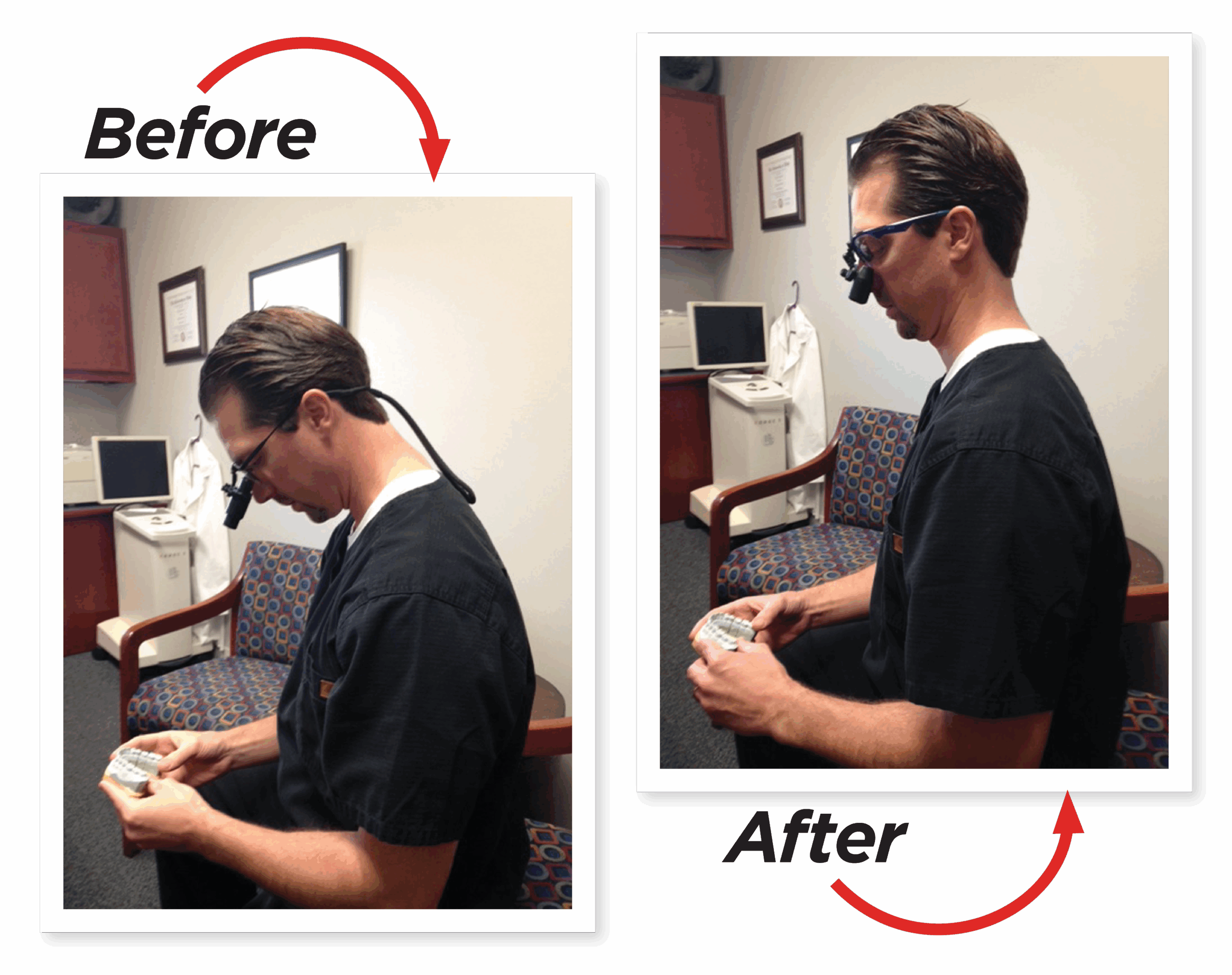
Non-Ergonomic Loupes vs. SurgiTel Ergonomic Loupes
Poorly designed or improperly aligned optics can cause chronic musculoskeletal strain, especially in the neck, shoulders, and lower back. Low-quality loupes with incorrect declination angles or poor balance force the clinician into a forward-leaning posture, increasing cervical stress by up to 300–400% during procedures.
According to ergonomic research in dental and surgical professions:
- Up to 80% of dental professionals experience work-related neck or back pain.
- MSDs are the leading cause of early retirement and reduced career longevity among clinicians.
- The estimated average cost of treating chronic neck/back issues over a 10-year career exceeds $20,000–$40,000 in direct medical expenses, and even more in lost productivity or time away from work.
By contrast, ergonomic optics like SurgiTel’s allow clinicians to maintain a neutral posture, reducing muscle strain and protecting long-term spinal health.
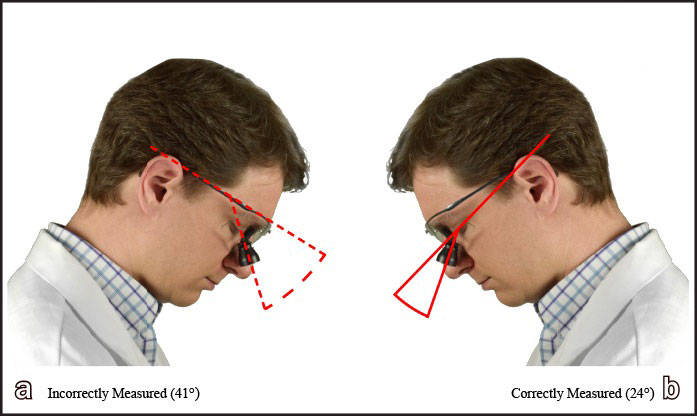
Declination Angle (a) Incorrectly Measured and (b) Correctly Measured
- The Financial Ripple Effect
| Category | Low-Cost Loupes | High-Quality Ergonomic Loupes |
| Replacement Frequency | Every 1–2 years | Every 7–10 years |
| Warranty & Support | Minimal | Full coverage |
| Visual Fatigue & Errors | Frequent, may affect accuracy | Rare, consistent performance |
| Postural Stress | High – poor declination angle | Low – designed for neutral posture |
| Long-Term Medical Cost (MSDs) | $20,000–$40,000+ | Negligible |
| Career Impact | Shortened due to chronic pain | Sustained performance and longevity |
When all factors are considered, the real cost of “cheap” optics can exceed 10–20 times the initial savings once health, comfort, and replacement frequency are accounted for.
- Investing in Longevity
Investing in high-quality optics is not just about performance, it’s about protecting your body and your career. A one-time purchase of well-engineered, ergonomic loupes is a preventive investment that pays dividends in:
- Reduced physical strain
- Fewer missed workdays
- Higher clinical precision
- Greater long-term earning potential
Investing $2,000–$3,000 in ergonomic equipment has the potential to help prevent tens of thousands of dollars in long-term costs associated with musculoskeletal injuries, medical treatment, and lost income.*
When viewed through this lens, the decision becomes clear: you either invest in quality once, or you pay for it, physically and financially, over the years.
*Dollar amount is an estimate.
Professional Support and Warranty Matters
Pop-up loupe sellers frequently operate through online-only channels with no local service or in-person support. Once the sale is complete, the user is often left without assistance if issues arise.
SurgiTel and other premium manufacturers, by contrast, provide:
- Local field representatives for fitting, adjustments, and training.
- Warranty-backed service and certified optical calibration.
- Repair and upgrade options to extend product life.
These services are integral to ensuring long-term satisfaction and optimal visual performance, benefits that are not reflected in the sticker price but make a lasting difference in daily use.
Perception vs. Reality for Younger Buyers
Younger clinicians entering the field often face tight budgets and are more influenced by online marketing and peer recommendations. Many underestimate how much precision optics impact posture, comfort, and fatigue. Because their eyes are more adaptable, they may not notice subtle misalignment or chromatic aberration, until much later in their careers.
Helping this audience understand the long-term benefits of quality optics requires education and direct demonstration. Field reps, universities, and distributors play a key role in bridging this knowledge gap, by focusing on how high-quality loupes protect vision, improve ergonomics, and sustain performance over an entire career.
Conclusion: Seeing the Difference
The choice between low-cost, low-quality loupes and precision-engineered optical systems like SurgiTel is ultimately about value, not price. High-quality optics are not just a tool, they are an investment in clinical excellence, visual health, and career longevity.
While new market entrants will continue to compete on price, the professionals who understand the science of vision and ergonomics will recognize that true quality lies in clarity, precision, and support, not in shortcuts.
As SurgiTel continues to lead through innovation in ergonomic design, optical engineering, and vision safety, the message remains simple:
“Your eyes and posture are for life, choose optics that protect them.”
References
- Valachi, Bethany, and Keith Valachi. “Preventing Musculoskeletal Disorders in Clinical Dentistry.” The Journal of the American Dental Association 134, no. 12 (December 2003): 1604–12. https://doi.org/10.14219/jada.archive.2003.0106.
- Valachi, Bethany, and Keith Valachi. “Mechanisms Leading to Musculoskeletal Disorders in Dentistry.” The Journal of the American Dental Association 134, no. 10 (October 2003): 1344–50. https://doi.org/10.14219/jada.archive.2003.0048.
- Ludwig, Emily A, Gayle B McCombs, Susan L Tolle, and Daniel M Russell. “The Effect of Magnification Loupes on Dental Hygienists’ Posture While Exploring.” Journal of Dental Hygiene 91, no. 4 (August 2017): 46–52. https://jdh.adha.org/content/91/4/46.
- Aghilinejad, Mashallah, Elaheh Kabir-Mokamelkhah , Atefeh Talebi, Roghayeh Soleimani, and Naser Dehghan. “The Effect of Magnification Lenses on Reducing Musculoskeletal Discomfort among Dentists.” Medical journal of the Islamic Republic of Iran 30 (n.d.). https://pmc.ncbi.nlm.nih.gov/articles/PMC5419231/.
- Mulimani, Priti, Victor CW Hoe, Melanie J Hayes, Jose Joy Idiculla, Adinegara BL Abas, and Laxminarayan Karanth. “Ergonomic Interventions for Preventing Musculoskeletal Disorders in Dental Care Practitioners.” Cochrane Database of Systematic Reviews 2018, no. 10 (October 15, 2018). https://doi.org/10.1002/14651858.cd011261.pub2.
- Çınar, Rumeysa, Sema Aydınoğlu, İpek Arslan, and Dilara Nil Günaçar. “Postural Effects of Dental Loupes in Pediatric Dental Practice?” BMC Oral Health 25, no. 1 (March 26, 2025). https://doi.org/10.1186/s12903-025-05766-0.
- Danylak, Stefan, Alastair J Sloan, Laurence J Walsh, and Sobia Zafar. “A Comparative Study of Postural Impact and Benefits from Loupes in Undergraduate and Graduate Dentists.” Journal of Dentistry 163 (December 2025). https://doi.org/10.1016/j.jdent.2025.106162.
- Chopra, Amandeep. “Musculoskeletal Disorders in Dentistry- A Review.” JSM Dentistry 2, no. 3 (n.d.). https://www.jscimedcentral.com/public/assets/articles/dentistry-2-1032.pdf.
- Valachi, Bethany. “3 Keys to Eliminating Neck Pain in Dentistry.” Posturedontics, n.d. https://posturedontics.com/the-top-5-keys-to-eliminating-neck-pain-in-dentistry/.
- Chang, Jin. “True Ergonomics from SurgiTel: The Truth about Declination Angle.” SurgiTel, n.d. https://www.surgitel.com/true-ergonomics-from-surgitel-the-truth-about-declination-angle.
- “Clinical Guidelines for Selecting Loupes.” Gordon J. Christensen Clinicians Report. Clinicians Report, August 2016. https://www.cliniciansreport.org/products/product/clinical-guidelines-for-selecting-loupes-is-overhead-led-lighting-ready-for-dental-operatories-are-scanning-and-milling-for-you-august-2016-volume-9-issue-8.
- “Cordless LED Headlamps: A Bright Idea?” Gordon J. Christensen Clinicians Report. Clinicians Report, May 2017. https://www.cliniciansreport.org/products/product/cordless-led-headlamps-a-bright-idea-wipe-disinfection-killing-or-spreading-the-germs-radiation-are-you-and-your-patients-and-staff-protected-%E2%80%93-may-2017-volume-10-issue-5.php